
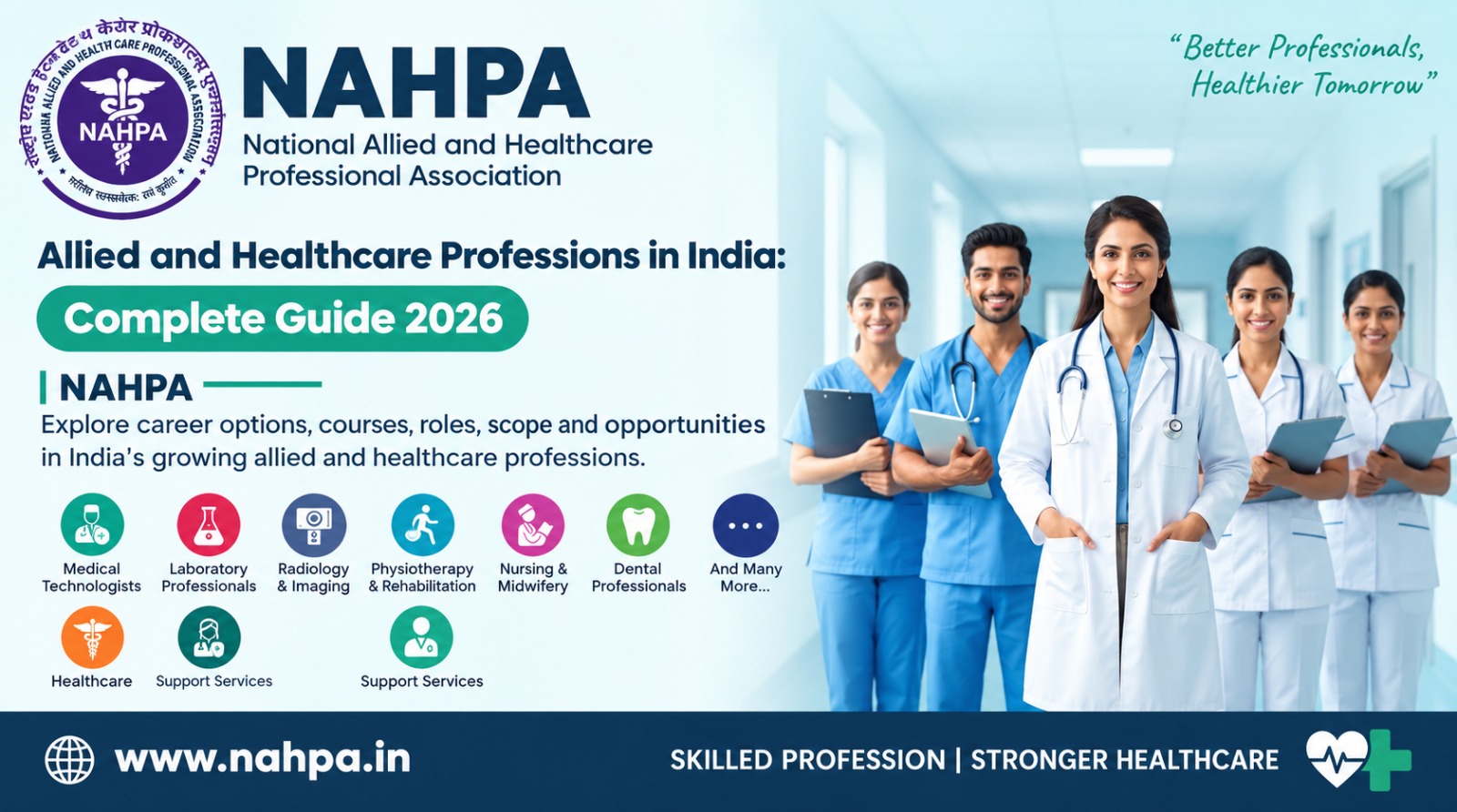
Allied and Healthcare Professions in India | Complete Guide 2026 | NAHPA
India's hospitals do not run on doctors and nurses alone. Behind every diagnosis, surgery and recovery stands a skilled workforce of allied and healthcare professionals — lab scientists, radiographers, physiotherapists, dietitians, optometrists, paramedics and many more. In 2026, this workforce is getting something it never had before: a single national registration system.
What Are Allied and Healthcare Professions?
Allied and healthcare professionals are trained specialists who support, deliver and enable clinical care — everything around the doctor's prescription. The Act 2021 defines them as technicians, technologists, therapists and scientists who support diagnosis, treatment and rehabilitation, with qualifications requiring at least 2,000 hours of training at the technician level or 3,600 hours at the professional level. They are distinct from doctors, dentists, nurses and pharmacists, who already have their own councils.
The 10 Recognised Categories
- Medical Laboratory and Life Sciences
- Trauma, Burn Care and Surgical/Anaesthesia Technology
- Physiotherapy
- Nutrition Science (Dietetics)
- Ophthalmic Sciences (Optometry)
- Occupational Therapy
- Community Care, Behavioural Health Sciences and Others
- Medical Radiology, Imaging and Therapeutic Technology
- Medical Technologists and Physician Associates (including paramedics)
- Health Information Management and Health Informatics
Career Scope in 2026
The outlook for allied and healthcare professionals is strong. Industry analyses estimate that allied health professionals make up roughly 60% of India's healthcare workforce, while studies have placed the supply-demand gap at around 6.5 million professionals. University estimates project 2–2.5 million new allied health jobs by 2030.
Entry-level salaries typically range from approximately ₹2.4–3.6 lakh per annum (LPA) for physiotherapy roles to an average of ₹2.6–2.8 LPA for laboratory and radiology technicians. Earnings can increase substantially with specialisation, experience and advanced qualifications.
Registration adds professional value by making verified credentials easier for employers to check, improving employment prospects in India and potentially supporting opportunities abroad.
How NAHPA Helps
NAHPA is a national association of allied and healthcare professionals with district-level units across Uttar Pradesh, Maharashtra, Bihar, Rajasthan, Gujarat, West Bengal, Madhya Pradesh, Tamil Nadu and other states. It represents professionals at the grassroots level and promotes awareness of registration requirements and continuing professional development (CPD) responsibilities.
To connect with your district unit, visit www.nahpa.in.
Frequently Asked Questions (FAQs)
What are allied and healthcare professions in India?
These are recognised professions that support and deliver clinical care outside medicine, dentistry, nursing and pharmacy. The Act 2021 recognises 57 vocations across 10 broad disciplines.
Who can connect with NAHPA for support?
Every cadre of India's healthcare workforce — doctors, nurses, physiotherapists, lab technologists, radiographers, optometrists, occupational therapists, AYUSH practitioners, paramedics, trauma and critical care technologists, hospital administrators and public health workers — plus students, socially conscious citizens, NGO leaders, philanthropists and youth volunteers.